
Best AI SEO Tools in 2026: A Practical Buyer’s Guide
Introduction
If you’ve searched for “best AI SEO tools 2026” more than once this month, you’re probably not confused about whether you need one — you’re confused about which one. That’s fair. The AI SEO space has split into so many overlapping categories that even experienced marketers struggle to tell a content optimization tool apart from an AI visibility tracker.
Here’s the short version of what’s happening: Best AI SEO Tools in 2026 isn’t just about ranking on Google anymore. It’s also about showing up inside AI-generated answers on ChatGPT, Perplexity, and Google’s AI Mode as search has shifted toward these AI-powered surfaces alongside traditional rankings. That shift has created two very different toolsets that most “best of” lists lump together without explaining the difference — which is exactly the confusion this guide is here to fix.
In this article, you’ll learn what actually separates an “AI SEO tool” from a traditional one, see a quick-glance comparison of the leading options, understand how to choose based on your budget and experience level, and get a clear final recommendation for different types of website owners — from solo bloggers to full agencies.The Best AI SEO Tools in 2026 can save you hours of manual SEO work. The comparison table below helps you quickly compare the top options.
This guide is built for beginners and small business owners first, but if you manage client SEO, the buying framework further down will apply to you too.
Why You Should Trust This Guide
Before recommending anything, you deserve to know how we got here — and where our limits are.
Our Research & Verification Methodology
Every tool mentioned in this guide was evaluated using publicly available information: official product pages, published pricing tiers, documented feature lists, and independent reporting from established SEO publications. Where tools serve overlapping purposes, we grouped them by primary job (content optimization, keyword research, or AI-visibility tracking) rather than forcing every tool into a single “best overall” ranking, since that’s rarely how these tools are actually used in practice.
We did not personally run paid trials of every tool listed here. Where that’s the case, Best AI SEO Tools in 2026 we say so directly instead of implying hands-on testing that didn’t happen — that’s a non-negotiable part of how we write at BlogsNestify.
Our Fact-Checking Process
Pricing and feature claims for SaaS tools change often — sometimes monthly. Before you make a purchasing decision based on anything in this article, confirm current pricing and features directly on the vendor’s official website. We’ve noted approximate pricing ranges where they were verifiable at the time of writing, but we’d rather send you to the source than risk showing you an outdated number.
Last Updated Policy
This guide reflects information available as of 2026. AI SEO tools evolve quickly — new features launch, pricing tiers shift, and entire product categories (like AI-visibility tracking) are still maturing. We plan to revisit this article as the market changes, and we’ll note the last review date at the top of the page once published.
Affiliate Disclosure
Some links in this article may be affiliate links, meaning we could earn a commission if you sign up through them, at no extra cost to you. This never influences which tools we include or how we rank them. If a tool isn’t a good fit for your budget or goals, we’ll tell you that — commission or not.
Best AI SEO Tools Comparison Table
Here’s a fast overview before we go deeper into each category. Think of this as your cheat sheet — the sections below explain the reasoning behind each pick.
The Best AI SEO Tools in 2026 can save you hours of manual SEO work. The comparison table below helps you quickly compare the top options.
| Tool | Best For | Primary Job | Starting Price* | Free Option |
|---|---|---|---|---|
| Surfer SEO | Content optimization | Scoring content against top-ranking pages | ~$79/month | No free plan |
| Frase | Budget-conscious teams | Content briefs + basic AI-visibility scoring | ~$39/month | Limited trial |
| Clearscope | Optimizing human-written content | Content scoring & relevance | Custom pricing | No |
| Ahrefs | Research backbone | Backlink data, keyword research, competitor analysis | ~$29/month (entry tier) | No |
| Semrush (AI Toolkit) | All-in-one strategy | Keyword research, audits, AI-visibility tracking | Higher-tier pricing | Limited free tools |
| Peec AI | Agencies tracking AI visibility | GEO/AEO tracking across ChatGPT, Perplexity, Gemini | ~$89/month | No |
| Ubersuggest | Beginners & solo site owners | Budget-friendly all-in-one | ~$29/month or one-time lifetime option | Limited free tier |
*Pricing shown reflects publicly reported figures at the time of research and may have changed. Always verify current pricing on the vendor’s official pricing page before subscribing.
A pattern worth noticing here: most of these tools are not direct competitors. Surfer SEO is stronger for optimizing one specific piece of content against a live SERP, while Semrush’s AI tools are built more for managing SEO strategy across an entire site or client portfolio — so the “best” tool really depends on which job you’re hiring it to do.
What Makes an AI SEO Tool in 2026?
This is the part most buying guides skip — and it’s the part that actually matters most if you’re new to this.
Traditional SEO Tools vs. AI-Powered SEO Tools
A traditional SEO tool helps you research keywords, audit your site, and track rankings — tasks that have existed since the early 2010s. An AI-powered SEO tool does those same jobs but uses machine learning to speed up or improve the analysis. For example, instead of manually sorting a spreadsheet of keyword variations into topics, AI-driven clustering can automatically group thousands of keyword variants into intent-based topics, work that used to take a strategist days to do by hand.
In practice, this shows up as features like:
- Automatic content scoring against top-ranking competitors
- AI-generated content briefs based on what’s already ranking
- Search intent detection without manual SERP analysis
- Suggested internal linking and topic gaps
None of this replaces strategic judgment. As one industry source puts it plainly, these tools accelerate research and optimization, but they don’t guarantee rankings, and they replace repetitive analysis work rather than the judgment needed to interpret results and catch a tool’s own mistakes.
What Is GEO/AEO — and Why It Now Matters
Here’s the newer, less-understood half of the category. GEO (Generative Engine Optimization) and AEO (Answer Engine Optimization) refer to the practice of improving how your brand or website shows up inside AI-generated answers — think ChatGPT responses, Google’s AI Overviews, or a Perplexity summary — rather than just in a traditional list of blue links.
This is a genuinely new discipline, and it’s easy to miss if you’re only familiar with classic SEO tools. As one 2026 industry analysis frames it, most “best AI SEO tools” roundups treat two completely different disciplines as if they were one category — traditional AI-powered SEO, which is mature and well understood, and GEO, which is new, fast-growing, and tracks how a brand appears inside AI-generated answers on platforms like ChatGPT, Perplexity, Gemini, and Google AI Mode.
If you’ve only ever optimized for Google’s traditional results page, GEO tools are worth understanding now, even if you’re not ready to invest in one yet. Tools built specifically for this purpose track things like whether ChatGPT cites your site, how often your brand appears in AI-generated summaries, and where competitors are being mentioned instead of you.
We’ll break down specific tools for both categories — traditional AI SEO and GEO tracking — in the sections ahead.
Sections completed: Introduction, Why You Should Trust This Guide, Quick Comparison Table, What Makes an AI SEO Tool in 2026?
Stopping here per your instructions. Let me know if these four sections look good, or if you’d like any adjustments (tone, table entries, depth) before I continue to the “Best AI SEO Tools in 2026 by Category” section.
Best AI SEO Tools by Category
Now that you understand what separates traditional AI SEO tools from GEO/AEO tools, let’s look at specific options for each job. Remember: these aren’t ranked against each other head-to-head, because they’re mostly built for different tasks. Pick the category that matches what you actually need help with.
Best for Content Optimization: Surfer SEO\
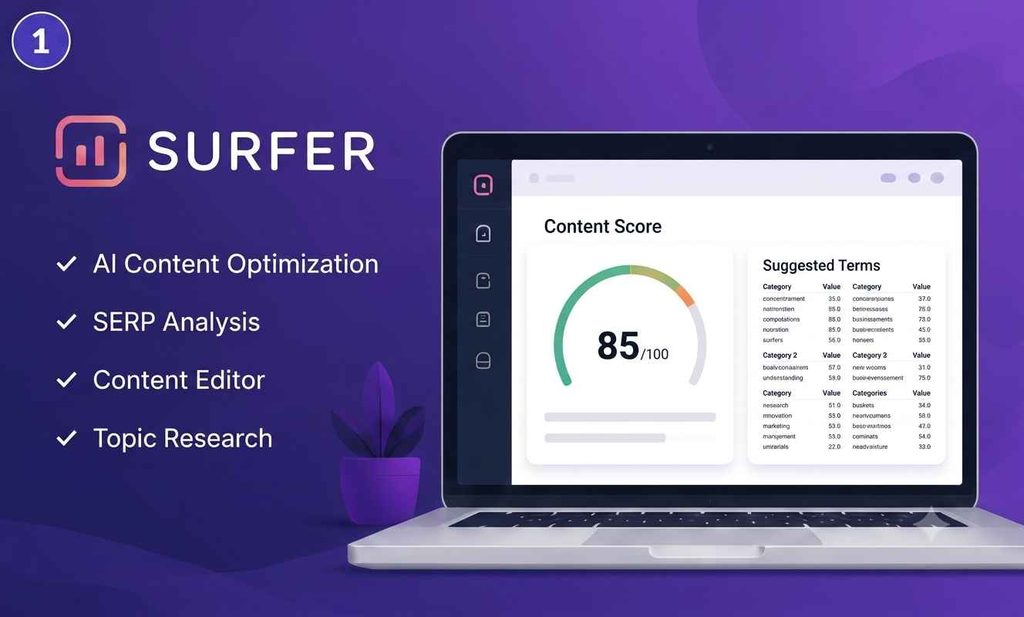
Short introduction If your content keeps getting outranked by pages that seem less thorough, Surfer SEO is built specifically to close that gap. It compares your draft against the pages currently ranking for your target keyword and tells you where you’re falling short.
Key features
- Content Score that grades your draft against top-ranking competitors in real time
- Keyword and topic suggestions pulled directly from ranking pages
- Content editor with live optimization feedback as you write
- SERP analyzer showing structural patterns among top results (headings, word count, common terms)
Pros
- Widely regarded as the standard for real-time content scoring
- Editor interface makes optimization approachable for non-technical writers
- Strong for optimizing a specific piece of content against a live SERP
Cons
- No free plan, so you can’t test it without paying
- Scoring systems like this can encourage writers to chase a number instead of writing naturally — use it as a guide, not a rulebook
- Less useful for site-wide strategy compared to all-in-one platforms
Best for: Bloggers and content teams who already know what to write about but want confirmation they’ve covered the topic thoroughly enough to compete.
Pricing: Reported starting around $79/month for entry-level plans. Please verify current pricing directly on Surfer’s official website, as SaaS pricing changes frequently.
Honest recommendation: Best AI SEO Tools in 2026 If your main bottleneck is “why does my competitor’s article outrank mine when mine is more detailed,” Surfer is worth the investment. If you’re still deciding what to write about in the first place, you’ll want a keyword research tool before this one.
Best for Keyword Research & Clustering: Ahrefs
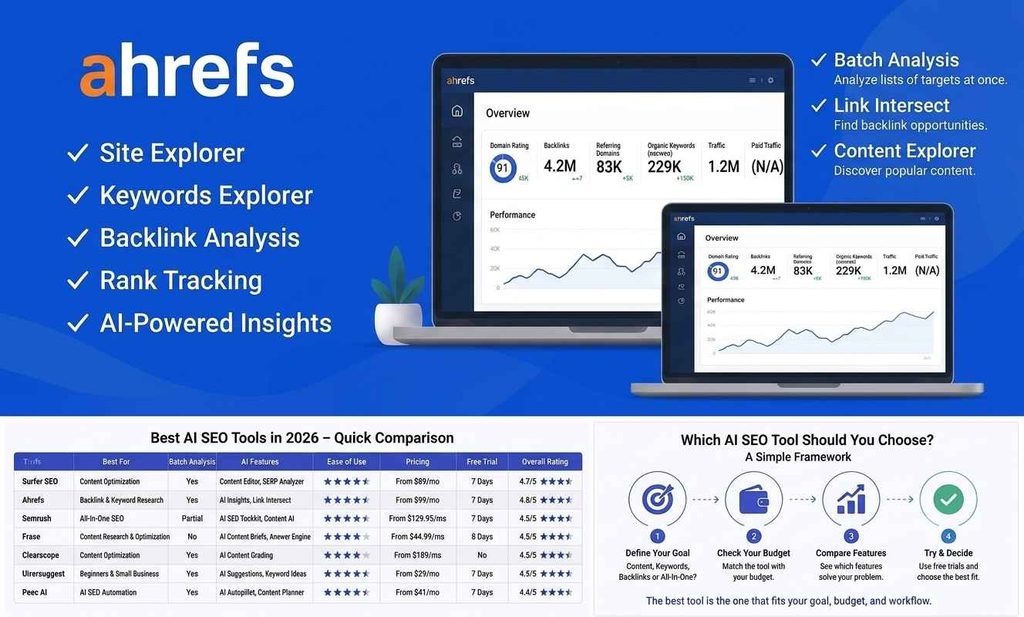
Short introduction Ahrefs has built its reputation over more than a decade on one core strength: a large, frequently updated backlink and keyword database. In 2026, that foundation still holds, and the platform has layered AI-assisted features on top of it.
Key features
- Site Explorer for backlink and competitive analysis
- Content Explorer for finding content angles and gaps
- Keyword clustering that groups related search terms into intent-based topics automatically
- Competitor keyword gap analysis
Pros
- One of the most trusted backlink datasets in the industry
- Excellent for understanding a competitor’s overall position quickly — often revealing more in ten minutes than a manual audit would in an hour
- Keyword clustering reduces hours of manual spreadsheet work
Cons
- The full feature set can feel overwhelming for absolute beginners
- Backlink-focused strength means content optimization features are comparatively less developed
- Entry-level pricing has become more accessible recently, but higher tiers still add up for advanced features
Best for: Anyone doing serious competitor research, agencies onboarding new clients, or site owners building a long-term link-building strategy.
Pricing: Entry-level plans have been reported starting around $29/month, though full-feature tiers cost considerably more. Confirm current tiers and limits on Ahrefs’ official pricing page, since entry-level offerings have shifted in recent periods.
Honest recommendation: If you need to understand Best AI SEO Tools in 2026 why a competitor ranks and what keywords are realistically within reach, Ahrefs remains one of the strongest research backbones available — even if you eventually pair it with a separate content optimization tool.
Best for AI Search Visibility Tracking (GEO/AEO): Peec AI
Short introduction This is the newer, less familiar category we introduced earlier — tools built specifically to track how your brand appears inside AI-generated answers rather than traditional search results. Peec AI is one of the tools built specifically for this purpose.
Key features
- Tracks brand mentions and citations across ChatGPT, Perplexity, and Gemini
- Monitors competitor visibility within the same AI-generated answers
- Reporting designed for multiple client accounts, which suits agency use
Pros
- Purpose-built for a genuinely new and fast-growing discipline most competitors ignore
- Unlimited user access on some plans makes it practical for agency teams
- Fills a real measurement gap — traditional rank trackers can’t tell you if ChatGPT is citing you
Cons
- This entire tool category is still maturing, so expect faster changes to features and pricing than in established SEO tools
- Less useful if your traffic goals are purely traditional-search focused
- We have not personally tested this tool hands-on; this assessment is based on available product information and industry reporting
Best for: Agencies and brands that already have traditional SEO handled and want visibility into how they’re represented in AI-generated answers.
Pricing: Reported starting around $89/month. Verify current pricing directly on the official website, especially since this category is evolving quickly.
Honest recommendation: If you’re a solo blogger just starting out, this likely isn’t your first purchase — get your traditional SEO foundation solid first. If you’re an agency or established brand, this category is worth budgeting for now rather than waiting.
Best All-in-One Platform: Semrush (AI Toolkit)
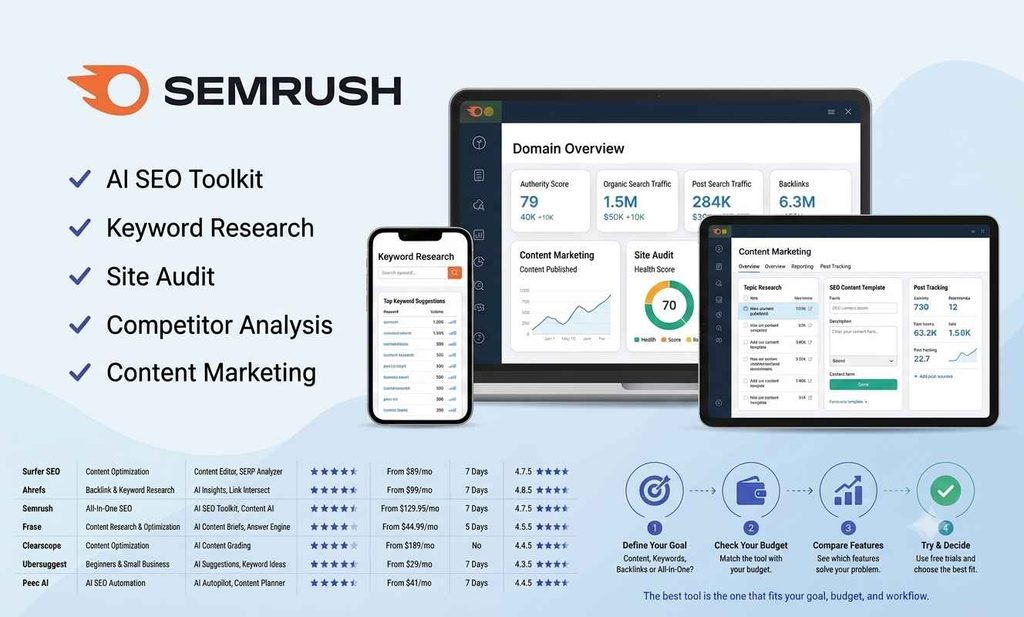
Short introduction Semrush has long been one of the most recognized names in SEO, and its AI-focused toolkit now bundles keyword research, site audits, competitor analysis, and AI-visibility tracking into a single platform.
Key features
- Keyword research and rank tracking across traditional search
- Site audit tools for technical SEO issues
- Competitor analysis, including advertising and backlink strategies
- AI visibility tracking across major AI search surfaces in newer toolkit additions
Pros
- Covers the widest range of tasks in one subscription, reducing the need to juggle multiple tools
- Strong competitor analysis features that show ranking, ad, and backlink strategies together
- Frequent updates keep pace with a changing SEO landscape
Cons
- Pricing sits at the higher end compared to single-purpose tools
- Most plans support only one user, which can be limiting for growing teams
- The breadth of features means a learning curve for new users
Best for: Small business owners and marketing teams who want one platform covering strategy, technical health, and AI visibility instead of piecing together several subscriptions.
Pricing: All-in-one plans have been reported starting around $165/month billed annually for full-featured tiers. Check Semrush’s official pricing page for current plans, as tiers and included features change.
Honest recommendation: If budget allows and you’d rather manage one dashboard than five, this is a reasonable consolidation choice. If you’re just starting out, the price point may be more than you need before you’ve validated your content strategy.
Best Free / Budget-Friendly Option: Ubersuggest
Short introduction Ubersuggest positions itself specifically for solo site owners and small businesses who want core SEO functionality without enterprise-level pricing.
Key features
- AI-assisted keyword overview and prompt ideas
- Basic AI search visibility features
- Site audit and rank tracking for a limited number of sites depending on plan
Pros
- Genuinely affordable compared to most tools on this list
- Some reporting suggests a one-time lifetime-access option has been available, which is unusual in a market dominated by monthly subscriptions
- Reasonable starting point for someone managing just one or two personal or small business sites
Cons
- Feature depth doesn’t match higher-priced platforms like Ahrefs or Semrush
- Smaller keyword and backlink database compared to more established tools
- May require upgrading sooner than expected if your site grows quickly
Best for: Solo bloggers, personal website owners, and small businesses who want to avoid overspending before they’ve proven their content strategy works.
Pricing: Reported around $29/month for entry-level plans, with a one-time lifetime-access option mentioned in some sources. Verify current pricing and whether the lifetime option is still available on the Ubersuggest official website, since promotional pricing structures like this can change or be discontinued.
Honest recommendation: This is a sensible starting point if you’re testing the waters with SEO and don’t want to commit to a $79–$165/month tool before you know if you’ll stick with content creation long-term. Plan to reassess once your traffic or client list grows.
Section completed: Best AI SEO Tools by Category (all five subsections)
Stopping here per your instructions. Let me know if these tool write-ups look good — including tone, balance, and pricing disclosures — before I continue to the “Which AI SEO Tool Should You Choose?” decision framework section.
Which of the Best AI SEO Tools Should You Choose?
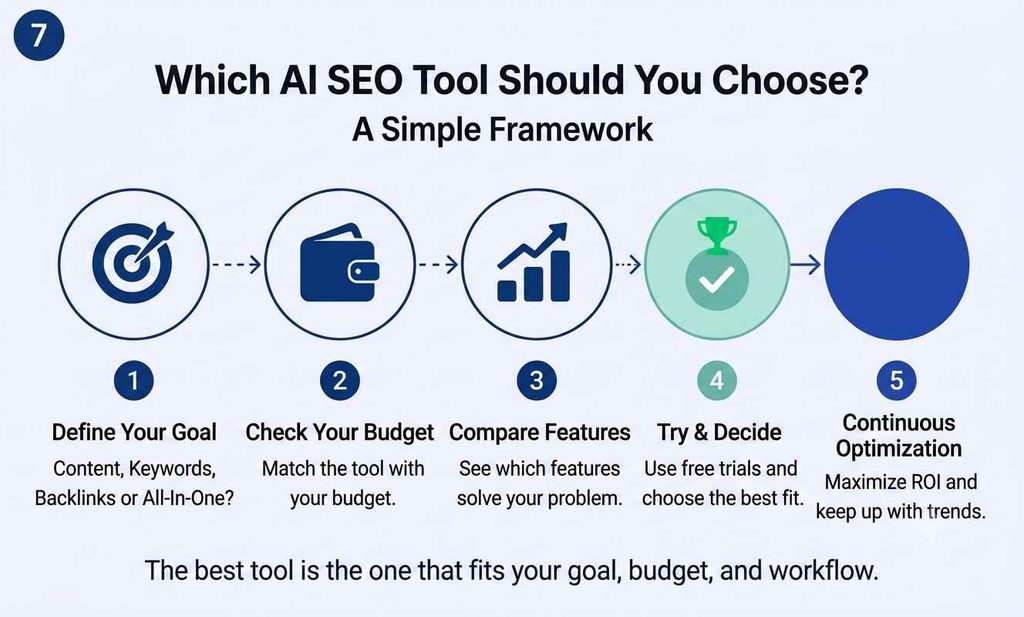
The tools above are only useful if they match where you actually are right now. Here’s a quick-reference breakdown by situation.
| If you are… | Start with | Why |
|---|---|---|
| Beginner | Ubersuggest | Low cost lets you learn core SEO concepts (keywords, rankings, basic audits) without a big financial commitment while you’re still figuring out if this is a long-term project. |
| Blogger | Surfer SEO | Once you know your niche and are publishing regularly, content-scoring tools like Surfer help you close the gap with competitors who are already ranking. |
| Small Business | Semrush (AI Toolkit) | One dashboard covering strategy, technical audits, and competitor tracking reduces the time you’d otherwise spend managing multiple subscriptions on top of running a business. |
| Agency | Ahrefs + Peec AI | Ahrefs gives you the research depth needed across multiple client accounts, while Peec AI adds the AI-visibility reporting clients are increasingly asking about. |
| Enterprise | Semrush (AI Toolkit) + dedicated GEO tracking | At scale, you need both a strategy-level platform and dedicated AI-visibility monitoring across brand and competitor mentions — a single all-in-one tool typically can’t cover both well enough for enterprise reporting needs. |
A quick gut-check before you commit to any of these: the right tool is the one that solves the problem you have right now — not the one with the longest feature list. A solo blogger buying an enterprise-grade platform is just as mismatched as an agency trying to run ten client accounts through a single-user beginner tool.
Common Mistakes When Choosing the Best AI SEO Tools
Even with a clear budget and goal, it’s easy to pick the wrong tool. Here are the mistakes we see most often.
Trusting a tool’s data without cross-checking it. Keyword volumes and ranking estimates can vary noticeably between platforms. Before trusting a new tool’s numbers, compare them against Google Search Console — if a tool’s keyword volumes are consistently off by more than 15–20%, or its optimization suggestions contradict your Search Console data, that’s a signal to reconsider it.
Buying based on feature count instead of actual need. More features don’t help you if you never use them. A content optimization tool with fifty features is worse for a beginner than a keyword tool with five features they’ll actually use every week.
Assuming AI tools replace strategic judgment. These tools accelerate research and content optimization, but none of them can guarantee rankings — search engines weigh far more signals than any single tool can see. Use them to speed up analysis, not to make final decisions for you.
Ignoring the GEO/AEO category entirely. If you only optimize for traditional Google rankings, you may be missing a growing share of discovery happening through ChatGPT, Perplexity, and AI Overviews. You don’t need to buy a GEO tool immediately, but you should at least understand the category before dismissing it.
Committing to annual billing before testing monthly. Many platforms offer discounted annual plans, but locking in a year before you know the tool fits your workflow is a common regret. Start monthly, then switch to annual once you’re confident.
Skipping the free trial or demo. If a tool offers a trial period, use it deliberately — run it against a real project rather than just browsing the dashboard. A short, focused test tells you more than a week of casual poking around.
Our Final AI SEO Tool Recommendations
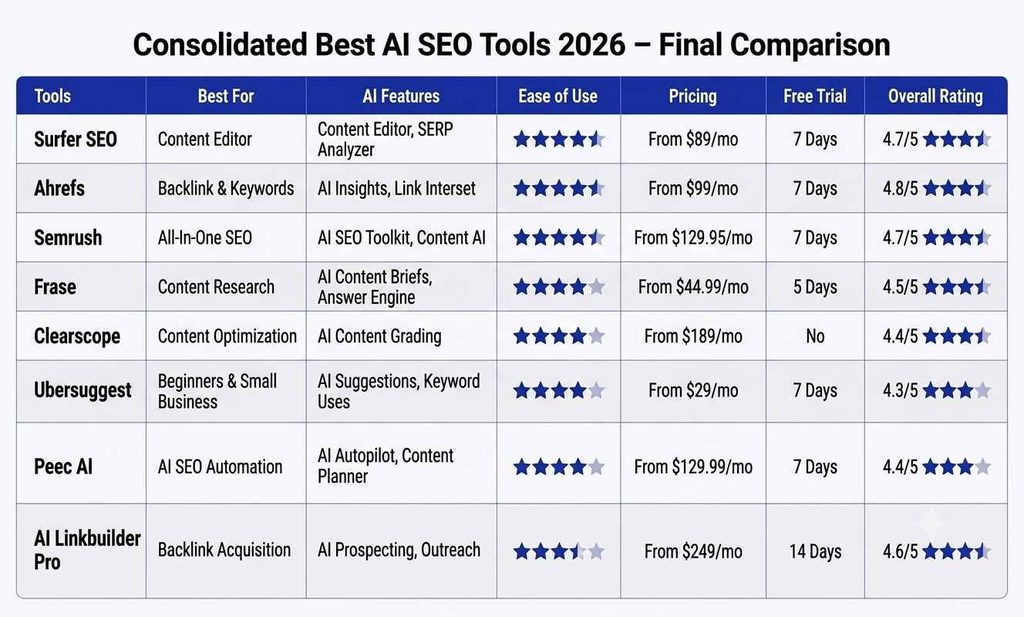
If you only remember five picks from this entire guide, make it these.
Overall: Semrush (AI Toolkit)
For readers who want one platform that reasonably covers keyword research, technical audits, competitor tracking, and emerging AI-visibility features, Semrush’s breadth makes it the most complete single subscription on this list — provided the pricing fits your budget.
Great Value: Frase
For teams that want content briefs and basic optimization scoring without committing to Surfer’s or Semrush’s higher price points, Frase offers a lower entry cost while still covering the essentials most bloggers need.
Good for Beginners: Ubersuggest
If you’re not yet sure whether you’ll stick with content creation long-term, Ubersuggest lets you learn the fundamentals without a heavy financial commitment.
Best for Agencies: Ahrefs (paired with Peec AI)
Ahrefs’ research depth handles the competitive analysis agencies need across multiple accounts, while adding Peec AI covers the AI-visibility reporting clients increasingly expect.
GEO Tool: Peec AI
As one of the few tools built specifically to track brand visibility inside AI-generated answers across ChatGPT, Perplexity, and Gemini, Peec AI is the clearest option in this still-emerging category.
A reminder that applies to every recommendation above: verify current pricing, plan limits, and feature availability directly on each tool’s official website before subscribing. Everything here reflects publicly available information at the time of writing, and SaaS offerings change often.
Frequently Asked Questions
What are the best AI SEO tools in 2026?
- Semrush: All-in-one SEO tool jo ChatGPT aur Google AI Overviews me aapki brand visibility ko track karta hai.
- Ahrefs: Best for backlinks and tracking your brand authority across AI models, Reddit, aur YouTube.
- Surfer SEO: Best for content optimization jo real-time NLP scoring ke sath articles ko top rank karne me help karta hai.
- Scalenut: Automated tool jo keyword clustering se lekar final SEO content draft karne tak sab autopilot par karta hai.
Do I need both a traditional SEO tool and a GEO tool?
Not necessarily right away. If you’re just starting out, focus on traditional SEO fundamentals first — keyword research, content optimization, and technical health. Once that foundation is solid, adding a GEO tool makes sense, especially if a meaningful share of your audience discovers content through AI search platforms.
Can AI SEO tools guarantee higher rankings?
No. These tools can speed up research, highlight gaps in your content, and show you what’s working for competitors, but no tool can guarantee a ranking, since search engines weigh many signals that aren’t visible in any single platform.
Are free AI SEO tools worth using?
Free or low-cost tools like Ubersuggest can be genuinely useful for beginners learning the basics, but they typically have smaller databases and fewer features than paid platforms like Ahrefs or Semrush. They’re a reasonable starting point, not necessarily a permanent solution as your site grows.
How often should I re-evaluate my AI SEO tool stack?
Given how quickly this space is changing — particularly around AI-visibility tracking — it’s worth reassessing your tools every six to twelve months, or sooner if you notice a tool’s data consistently disagreeing with Google Search Console.
What’s the difference between SEO and GEO?
Traditional SEO focuses on ranking in classic search results pages. GEO (Generative Engine Optimization) focuses on how your brand or content appears inside AI-generated answers on platforms like ChatGPT, Perplexity, and Google’s AI Mode. They’re related but require different tracking and, in some cases, different optimization approaches.
Related Guides You May Find Helpful
Want to improve your SEO knowledge even further?
Our latest guides on AI tools, SEO strategies, and affiliate marketing to build a stronger website and grow your online business.
- AI Tools – Explore the latest AI tools to improve SEO, content creation, and productivity.
- SEO Tips – Learn proven SEO strategies to increase rankings and organic traffic.
- Affiliate Marketing – Discover beginner-friendly affiliate marketing guides to monetize your website.
- Social Media Marketing– Discover AI software, content generators, image creators, and marketing automation tools.
- Google Ads– Discover AI software, content generators, image creators, and marketing automation tools.
Conclusion
Choosing the right AI SEO tool in 2026 isn’t about finding a single “best” option — it’s about matching the tool to the job you actually need done. A solo blogger and an agency managing twenty client accounts have almost nothing in common in terms of what they should buy, even if they’re both searching the same “best AI SEO tools” list.
Choosing the Best AI SEO Tools in 2026 depends on your goals, budget, and experience.
Start by identifying whether your immediate need is content optimization, keyword research, or AI-visibility tracking, then choose from the category that matches. If you’re still early in your content journey, there’s no shame in starting with a budget-friendly option like Ubersuggest and upgrading once you’ve proven the strategy works.
Whatever you choose, treat these tools as accelerators for your judgment — not replacements for it. The sites that consistently perform well in 2026, whether in traditional search or AI-generated answers, are the ones built on genuinely useful content, with the right tools simply helping that content get discovered faster.